 By Jeremy Koenig | Ad Creative Optimization | April 16, 2026 | 7 Min Read
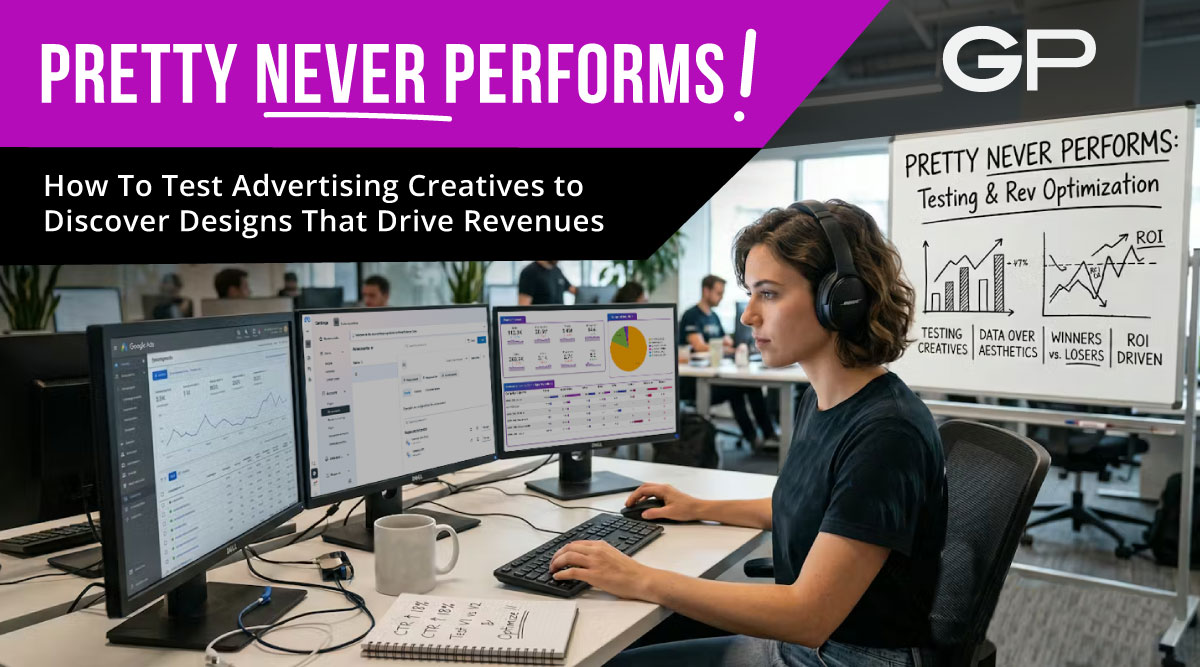
Modern media buying and corresponding ad creative optimization has fundamentally changed. Algorithms now optimize advertising campaigns faster than humans ever could, targeting has become broader and less deterministic, and competition for attention is fiercer than ever. In this environment, one truth stands out:
Optimized ads beat designed ads every time.
The brands that win today are not the ones with the most polished ads—they are the ones that systematically test, learn, and iterate. “Pretty” ads might win design awards, but they rarely win revenue. Performance comes from disciplined experimentation, strong messaging angles, and a relentless focus on what actually converts.
This article breaks down how high-performing media buyers approach creative testing to consistently uncover designs that drive real business results.
Bonus Video:
Genius Digital Marketing Crash Course 104: Call-to-Action that Converts (4:26)
Chapter 1 Discover Your Angle First Then Focus on Creatives
Most advertisers make a critical mistake: they start by designing ad creatives instead of discovering and defining angles.
An angle is the core message or perspective behind your ad. It’s the strategic foundation that determines whether your creative resonates at all. Without a strong angle, no amount of design polish will save performance.
Examples of strong angles include:
- Pain points (Example: “Tired of slow, outdated systems?”)
- Outcomes (Example: “Double your productivity in 30 days”)
- Identity (Example: “Built for multi-location operators”)
- Proof (Example: “Trusted by 10,000+ businesses”)
Instead of creating one idea and refining it endlessly, start with 3–5 completely different angles. Each should feel like a distinct narrative. From there, build creatives around each angle.
Key insight:
Angles drive performance and campaign optimization more than design aesthetics.
Chapter 2 Aggressively Test Ads and Iterate Fast
Creative optimization is not about perfection—it’s about volume and speed.
Top-performing paid social media and paid web search media buyers treat ads as experiments, not finished products. They launch multiple variations, quickly identify winners, and iterate without hesitation.

A strong baseline:
- 10–30 new creatives per week
- Multiple variations per angle
- Continuous testing cycles
Expect most creatives to fail. In fact, failure is the point. The goal is to uncover the small percentage of ads that outperform everything else.
Equally important is speed:
- Kill underperformers quickly
- Double down on early winners
- Launch new variations weekly
The faster you learn, the faster you scale.
Chapter 3 Leverage AI Generated and Stock Content for Video, Photo and Headline Experiments
AI tools and stock assets have become essential components of modern creative production—but only when used strategically.
AI excels at:
- Generating large volumes of hooks and headlines
- Creating script variations
- Reframing messaging for different audiences
- Producing rapid visual concepts

Source: Nano Banana
Stock images and video are valuable for:
- Quickly testing new ideas
- Building early-stage creatives
- Providing supporting visuals and background footage
However, both have limitations. AI-generated visuals can feel artificial, and stock assets often appear generic. Neither should be relied on as the final form of high-performing ads.
The best approach is a hybrid workflow:
- Use AI to generate ideas and variations
- Use stock assets to test quickly and cheaply
- Replace winning concepts with authentic, real-world content
In short:
AI and stock accelerate testing—but authenticity drives conversions.
Chapter 4 Scale Winning Motifs for Each ICP (Ideal Customer Profile)
Once you identify a winning creative, the real content marketing opportunity begins.
High-performing ads are rarely one-offs—they are patterns. A strong hook, visual style, or message can often be adapted across multiple audiences.
This is where motif scaling comes into play.

For each Ideal Customer Profile (ICP):
- Adjust messaging to match their specific pain points
- Modify visuals to reflect their environment or industry
- Tailor examples and proof points to their context
For example, a winning concept for retail operators can be adapted for:
- Auto dealerships
- Franchise businesses
- Property management companies
The structure stays the same, but the details change.
This allows you to scale efficiently while maintaining relevance.
Chapter 5 Start with Native Looking Ads That Match Platform Styles (Simple User Generated Feeling is Best)
Modern ad platforms reward content that feels native to the user experience.
Highly polished, overly produced ads often underperform because they immediately signal “advertisement.” In contrast, simple, user-generated-style content blends into the feed and earns attention naturally.

Best practices include:
- Designing ads that match the look and feel of the platform
- Using real people, real environments, and natural language
- Prioritizing authenticity over production quality
User-generated content (UGC) consistently outperforms traditional creative because it builds trust faster. It feels relatable, believable, and less scripted.
The more your ad looks like content, the better it performs.
Chapter 6 Focus on Performance Metrics that Actually Matter—Specifically CPA and ROAS
Creative decisions should always be guided by performance data—not opinions.
The two most important metrics are:
- Cost Per Acquisition (CPA)
- Return on Ad Spend (ROAS)
These metrics directly reflect business outcomes.

Supporting metrics like click-through rate (CTR) and engagement can help diagnose issues, but they should never be the primary optimization goal.
For example:
- High CTR but low conversions → messaging mismatch or poor landing page
- Low CTR → weak creative or hook
The key is to connect creative performance to revenue outcomes, not just surface-level engagement.
Chapter 7 Optimize Landing Pages for Each Level of Your Sales Funnel—Awareness, Engagement, and Conversions
Even the best creative cannot compensate for a poor post-click experience.
Your landing pages must align with the user’s stage in the funnel.

Awareness Stage
- Educational content
- Problem identification
- Low-friction engagement
Engagement Stage
- Clear benefits and differentiation
- Case studies and social proof
- Strong value proposition
Conversion Stage
- Direct offers
- Urgency and incentives
- Clear calls to action
A mismatch between ad messaging and landing page experience will destroy performance. Consistency is critical.
Conclusion: Build an Ad Creative Optimization System that Identifies and Scales Designs that Work
In today’s omnichannel marketing landscape, success is no longer about producing the most visually appealing ads—it’s about building a system that consistently identifies and scales what works.
The brands that win are those that:
- Test aggressively
- Iterate quickly
- Leverage data to guide decisions
- Prioritize authenticity over polish
At the forefront of this evolution is Giant Partners, an industry leader in omnichannel advertising campaigns. By combining data-driven technologies, advanced targeting strategies, and experienced media buying teams, Giant Partners helps brands move beyond guesswork and into predictable, scalable growth.
Because in modern advertising, one principle remains true:
Optimized ads beat designed ads every time.
Schedule Digital Advertising Strategy Discussion Today
Need help implementing ad creative optimization best practices to surpass new-customer-acquisition and ROI goals. Schedule a meeting below with a data driven marketing expert at Giant Partners and we will put together a custom solution for your organization.
Thank you for reading this article.
We look forward to working with you,

 Jeremy Koenig
Giant Partners
President of Digital Strategy
Connect on LinkedIn
About Giant Partners
25 years. 12,000 customers. GP is America’s #1 data driven marketing agency. We accelerate campaign performance with custom audience data, AI optimization, brand management, website development, CRM integration, email marketing, and omnichannel advertising.